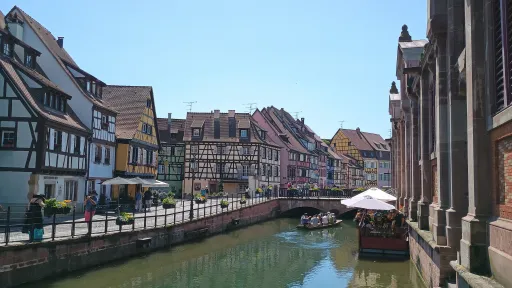
Colmar: timber-framed houses and the Isenheim altar
4 June 2026
Image
After breakfast we depart from Basel and reach Colmar around noon. We walk through the historical center with its many timber-framed houses and visit Saint Martins church.
Image
Big, beautiful timber-framed houses.
Image
Colmar features some nice squares. The statue on the fountain depicts Lazarus von Schwendi, a 16th century general serving the Habsburg emperors. It was created by Auguste Bartholdi in the late 19th century, whose museum at Colmar we are going to visit a little later.
Image
The richly decorated Maison Pfister is probably the most beautiful house at Colmar. It was constructed in the 16th century.
Image
A closer look at the paintings on the facade of Maison Pfister.
Image
We pass by the Dominican church, which contains a famous painting by Martin Schongauer, who was born and lived in Colmar. Unfortunately it was closed.
Image
Martin Schongauer lived in this house.
Image
Another street with beautiful timber-framed houses.
Image
In view of Maison Pfister and Saint Martins church.
Image
In view of Saint Martins church.
Image
A beautiful Gothic retable inside the church.
Image
The choir stalls are richly decorated. The lighting creates a peculiar atmosphere.
Image
Carved figures in the choir stalls.
Image
Figure of a cat and mice.
Image
Man with elephants head.
Image
Monkeys.
In the afternoon we do a boat tour in the channels of the part of the city that is called "petite Venise" (little Venice).
Image
Petite Venise. One can do a boat our in the channels with a boat like the one on the photo.
We still have some time afterwards, so we visit the Bartholdi museum inside the house where Auguste Bartholdi, the creator of the Statue of Liberty, was born. Part of the museum shows the reconstructed living rooms of the sculptor.
Image
"Lusterweibchen" in Bartholdis reconstructed office, depicting a Mermaid with bare breasts. The name is a wordplay in German, which can be translated as "chandelier woman", but is also reminiscent of "lustful woman". This type of chandelier was popular in the 16th century and then became outdated, but had a revival in the 19th century.
Image
The dining room features Chinese porcelain as part of the wall and ceiling decoration.
Image
This plaster sculpture of Vercingetorix was realized in 1902 at Clermont-Ferrand, near the site of his victory at Gergovia over the Romans.
After dinner we walk again a little through the town and admire the Maison des Têtes ("house of heads"), which got it's name because of the many heads decorating its facade.
Image
The Maison des Têtes was constructed in the early 17th century.
Image
A closer look at some of the heads.
The next day we visit a very interesting exhibition on books in the library of the Dominican order, then head to the Musée Unterlinden.
Image
Fountain in the cloister of Musée Unterlinden. Originally, the museum was a monastery.
The most famous work in the museum is of course the retable for the Isenheim altar painted by Matthias Grünewald in the early 16th century.
Image
The Isenheim retable in the close state, depicting Saint Sebastian and Saint Antonius on the sides, and the crucifixion and lamentation of Christ in the center.
Image
Resurrection and annunciation of Mary. The resurrection looks very modern though it is from the 16th century and is the panel that impressed me the most.
Image
Angels concert and Mary with child.
Image
Temptation of Saint Anthony and visiting Saint Paul the hermit.
Image
Sculptures of the Isenheim altar by Niklaus von Hagenau. The statue of Saint Antonius in the center seems almost lifelike.
But the Isenheim altar is not the only masterpiece at the Musée Unterlinden: I'm surprised to find a painting of Melancholia by Lucas Cranach the elder.
Image
Melancholia by Lucas Cranach the elder.
There are many more nice things to see; too many for this blog post, and they also kind of pale compared to Grünewalds altar paintings. After the museum we have lunch, then my friend returns to Basel and I continue to Metz.