After visiting Strasbourg cathedral, I spend the rest of the afternoon at the Maison de l'Oevre Notre-Dame, the former church masons guild which today contains a historical museum which contains some of the original sculptures of the cathedral.
Image
The Maison de l'Oevre Notre-Dame consists of a Gothic house from the 14th century with a stepped gable (left) and a Renaissance wing from the 16th century with a scroll gable (right). Even without the museum the building itself would be well worth a visit.
Image
Original sculptures of the victorious church (Ecclesia) on the left side, and defeated Synagogue with a broken spear, blindfolded eyes and averted gaze on the right side. They are from the portal of the southern transept of Strasbourg cathedral. Replacing the original sculptures on the facade with copies and putting them into a museum protects them from erosion and pollution. In the background other original sculptures and architectural pieces can be seen.
Image
Original sculptures of the wise virgins from the western facade of Strasbourg cathedral. The vessels they hold are oil lamps. The scene refers to a parable in the Gospel of Matthew where ten virgins await entry to a marriage feast. Five of them bring enough oil to keep their lamps burning and are let in when the bridegroom arrives in the night, whereas the five others run our of oil during the wait, walk off to buy some more and miss the arrival of the bridegroom, leading to them being shut out from the feast.
Image
Original sculptures of the seducer and two foolish virgins from the western facade of Strasbourg cathedral. The snakes and toads on the back of the seducer can clearly be seen here. While the man wearing a crown looks handsome and fashionably dressed up front, the vermin indicate his malevolent nature. The apple he is holding alludes to the fruit from the tree of knowledge and the Fall of Man after Adam and Eve were tempted to eat from it. This leaves little doubt about the true identity of the seducer. When looking closely, one can see that the virgins are holding their oil lamps upside down, indicating they are empty.
Image
The museum also contains beautiful stained glass windows that can be viewed up close. This one from the 12th century depicts an enthroned emperor.
Image
The Maison de l'Oevre Notre-Dame has a beautiful garden.
Image
The balcony is decorated richly with wooden carvings.
Image
Dormition of Mary, fragment of a wall painting from the 15th century from Eglise Sainte-Madeleine de Strasbourg
Image
A very detailed stained glass picture of the adoration of the magi from the 14th or 15th century.
Image
The archive of the Strasbourg church masons guild was a fire- and burglar-proof high security room where important documents were stored.
After the museum I conclude the day by strolling some more through the historical center before I eat something and return to the hotel.
Image
The historical center of Strasbourg is located on an island in the river Ill.
Image
The city features many half-timber houses. One of the most picturesque places at Strasbourg is La petite France ("little France"). The origins of the name are a lot less romantic than the looks of the quarter: In the 16th century it contained a hospital for people suffering from Syphilis. The first major outbreak of the disease occurred in the 15th century in the French army. Because of this, Syphilis was also known as the "French disease".
Image
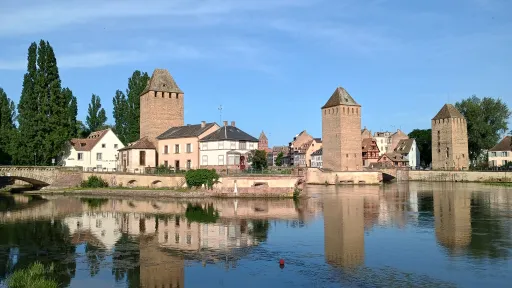
The Ponts couverts ("covered bridges") were part of the cities fortifications. Today only the towers remain.
Next morning I want to visit the Alsatian museum, but it is closed for renovation work. Thus, I start with the historical museum (luckily all those museums are pretty close together).
Image
The historical museum is located at the Great Abattoir from the 16th century, which replaced the old Medieval slaughterhouse.
Image
This cannon named "Le Sompteux" (the magnificent) from 1742 is interesting because its dimensions were standard at the time. It shot 24 pound cannon balls.
Image
This decoration from the 16th century was originally part of the facade of a house. It depicts a turret with two soldiers throwing stones.
Image
Sleighs from 17th/18th century.
After the historical museum there's still some time until the museums at the Palais Rohan open, so I decide to visit one of the nearby churches and choose Saint-Pierre-le-Jeune, the "new" Saint Peters church. This Romanesque church was consecrated in the middle of the 11th century by Pope Leo IX., thus the patrocinium of Saint Peter, whose deputy the pope is.
The church was reconstructed in the 13th century, some chapels were added in the 14th and 15th centuries. In the 16th century the church became Protestant, and was then divided between Protestants and Catholics in the 17th century after the conquest of the city by the French. The French revolution and the Franco-Prussian war 1870-71 led to much destruction. Today's state is the result of restoration work around 1900.
Image
The southern portal of Saint-Pierre-le-Jeune depicts Christ and reliefs from the Passion in the center and again statues of the wise and foolish virgins on the sides. It was created in the late 19th century in Neo-Gothic style because the original decorations were destroyed during the French revolution. Looking closely at the Crucifixion scene one can discern a depiction of the victorious Church to the left of the cross, and defeated Synagogue to the right of the cross. It seems like a deliberate reference to Strasbourg cathedral.
Image
Apostles and wise virgins to the left of the portal. The pedestals depict the months January to June and two of the four winds.
Image
Prophets of the old testament and foolish virgins to the right of the portal, with depictions of the months July to December and the other two winds. Note that this is the side of defeated Synagogue on the central relief above the portal.
Image
In view of the choir screen. Until the Council of Trent in the 16th century such screens separated the clergy in the choir from the laypeople in the nave. While Saint Peter was divided between Protestants and Catholics the choir screen was walled up and separated the two confessions. The Protestants used the nave as their church and the Catholics used the choir. The choir screen itself is from the 13th century. Its paintings are from the 17th century and depict the four evangelists. The organ on top is from the 18th century.
Image
The furnishings in the choir where the Catholics celebrated mass are mainly from the Baroque time. The central painting of the winged altar is from the 16th century, the side panels were added in the 19th century.
Image
The Chapel of Trinity was added to the church in the 15th century. The baptismal font too is from the 15th century, while the statues are from around 1900.
The nave of the church features impressive Medieval wall paintings which were restored (and partly painted over) in the 19th century.
Image
The gallery features the "Navicella", a painting from the 14th century showing the disciples in a boat on the stormy lake with Jesus walking on the water. It is inspired by a now lost mosaic of Giotto that decorated the old Saint Peters church at Rome.
Image
The "procession of nations" is from the 14th/15th century.
Image
Angel weighing souls and crucifixion.
Since the 11th century Saint Peter was a collegiate church. The beautiful cloister with three Romanesque sides and one Gothic side can also be visited.
Image
In view of the cloister with a central fountain. The contrast between the gothic arcade to the left and the Romanesque arcade to the right is evident.
Image
The cloister too features beautiful wall paintings.
I spend a lot of time at Saint Peter, in part because the nice guardian of the church recognizes my interest and spontaneously gives me a private guided tour. Afterwards I buy a written guide and some post cards to support my memory. I didn't expect this much from the church, but now I'm delighted. I wholeheartedly recommend it to anyone who visits Strasbourg.
I head to the Palais Rohan, the former seat of the prince-bishops belonging to the Rohan family. It contains three museums, an archaeological, handicraft and fine arts museum. My highlight are the representative rooms.
Image
Palais Rohan viewed across the Ill, with the cathedral in the background. The baroque palace was constructed between 1732 and 1742 and hosted some famous guests.
Image
Depiction of Ceres, the Roman goddess of agriculture at the so-called hall of synods. This room was an entrance hall where the palace guard was stationed. According to the written guide of the museum this room is "very plain and unadorned".
Image
The kings bedchamber served as, well, bedchamber for royal guests. King Louis XV. and Marie Antoinette slept here.
Image
The library is pretty pompous too.
Image
Originally a study, Napoleon Bonaparte chose this room as bedchamber. However, he never slept here.
I walk rather fast through the museums. In the fine arts museum I find a few paintings especially appealing.
Image
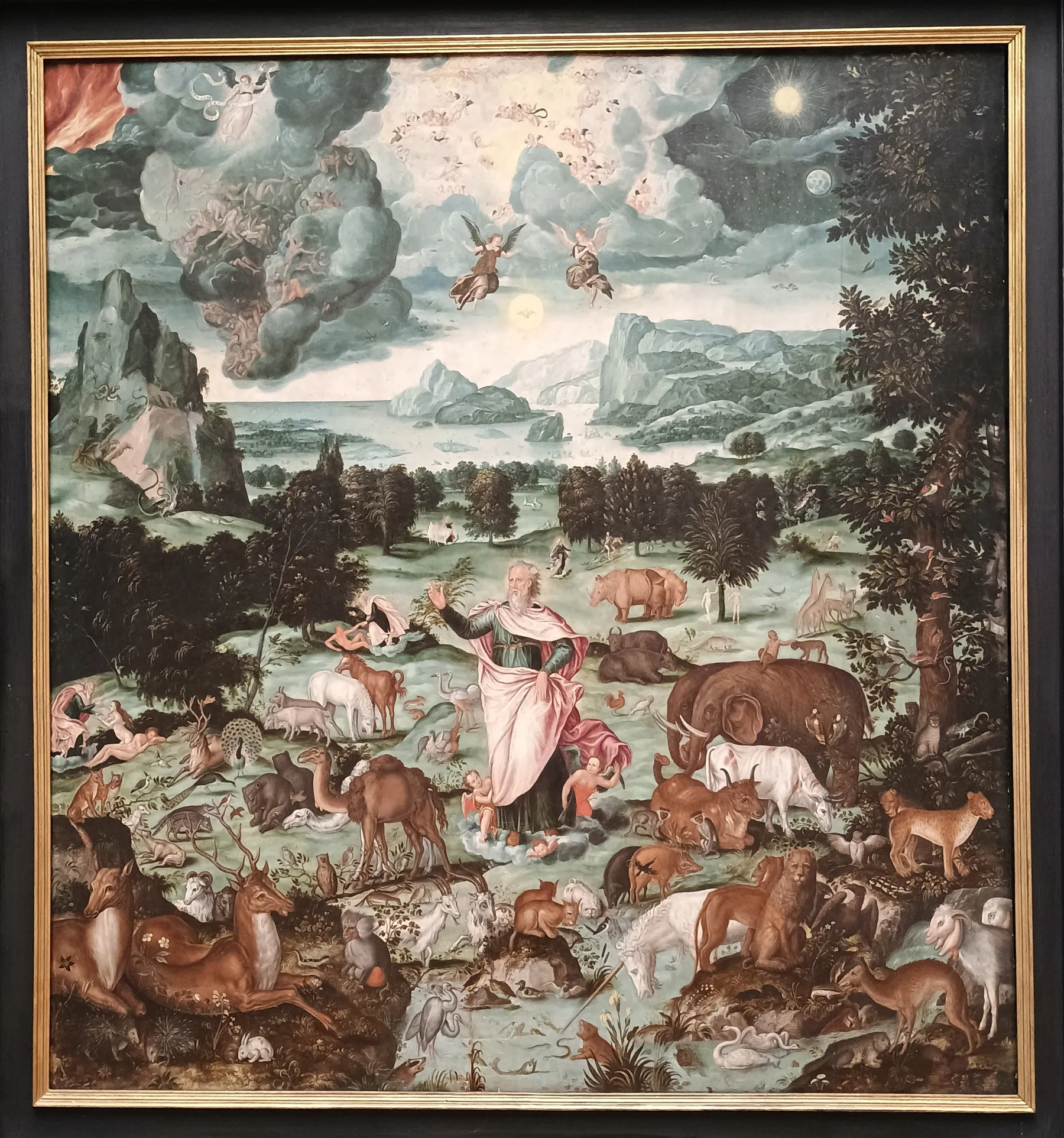
Melchior Bocksberger, La Création du Monde, 16th century.
Image
Nicolas de Largillierre, La Belle Strasbourgoise, 1703. This is maybe the most famous painting in the museum. The hat was fashionable in the upper classes of Strasbourg at that time. Fashionable maybe, but most likely pretty impractical.
After the Palais Rohan closes I walk around some more, buy a couple souvenirs and eat Baeckeoffa, a traditional Alsatian dish consisting of meat, potatoes and vegetables layered into a baking dish and cooked for several hours in an oven. It is a typical meal made from leftovers that was served on Mondays. Finally I return to the hotel. Next morning I board the train back to Vienna.
On my first day at Metz I walk along the river Mosel, explore the western part of the historical city center and encounter three very different churches.