Metz part 2: Musée de la Cour d'Or, fortifications, Jeanne d'Arc and even more churches
7 June 2026
Image
After having admired the cathedral, I continue to the nearby Musée de la Cour d'Or, a museum about the history of the city and the region located partly in a former church. Entry is free and the museum is huge, spanning a timeframe of almost two milennia from Roman times until the 19th century.
Image
This Roman tombstone from the 2nd or 3rd century depicts a jewellers shop. The museum has a huge collection of Roman artifacts and is located at the site of Roman baths, whose walls are part of the exhibition.
Image
Saint George slays the dragon and rescues the princess, with the parents watching from the safety of the castle. The fish may indicate the scene takes place near a body of water. The relief is from the 15th century.
Image
Fragment of a painted ceiling from the Medieval times depicting a hybrid creature.
Image
Fragment of a painted ceiling from the Medieval times depicting hybrid creatures.
Image
Hermann Hendrich, Lumière magique, 1892. This Romantic painting references the legend of the Flying dutchman, a ghost ship damned to sail the seven seas until the love of a young woman redeems the captain.
After the museum closes, I walk some more through the city, drink craft-beer and eat Flammkuchen at a park near the German gate and finally return to my hotel room.
Image
I walk back to the hotel via Place Saint Louis, which is crowded in the evening. The architecture of the buildings and the fact that much of life seems to happen outdoors give the city a kind of Mediterranean flair.
Image
This tower near my hotel belonged to the old fortifications, which are the focus of the next day. The walls clad in ivy give it a fairytale-like appearance.
Image
By the way, I have a nice look at Place Mondon from my window.
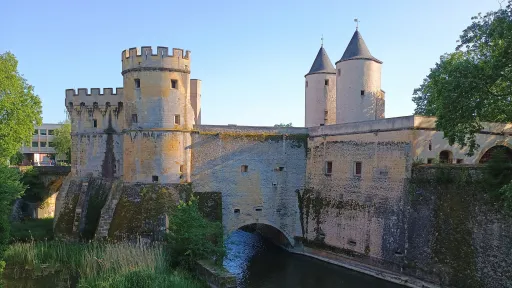
Next day I visit the German Gate, the last gate of the Medieval fortifications that is still standing. It was so formidable that the fortress architect Vauban who modernized the cities defenses in the 17th century integrated it into the new fortifications instead of demolishing it. I then walk alongside the remains of the city walls and the river Seille through nice parks. I didn't know that so much of the city walls is still standing.
Image
The formidable German gate contains a fortified bridge over the river Seille.
Image
This tower reveals its vault. The Medieval city walls consisted of 67 towers and and 17 gates. Many of the towers were maintained by the guilds of the city, which is reflected in the names of the towers.
Image
Today the tour along the city walls offers fresh air and cool shade.
Image
It would have been hard for an attacker to storm this gate.
I'm north of the historical center now and decide to visit the nearby church Saint Ségolène and Place Jeanne d'Arc. In the years following the execution of Jeanne d'Arc in 1431 several women claimed to be her, among them Jeanne des Armoises, who lived at this square at Metz, which is where the name of the square comes from.
Image
Place Jeanne d'Arc, in view of Saint Ségolène. It's a nice, quiet square.
Image
The portal of Saint Ségolène is beautifully decorated. The church dates back to the 12th century.
Image
Armed men, detail of the church portal.
During my tour through the city I also manage to visit some more churches: Saint Martin and Saint Eucaire which both contain wall paintings from the 15th century, as well as Saint Maximin which combines its Romanesque flair with modern glass windows.
Image
Wall paintings from the 15th century at Saint Martin.
Image
The altar of Saint Eucaire is flanked by statues of Jeanne d'Arc and archangel Michael.
Image
Statue of Jeanne d'Arc, Saint Eucaire. The pedestal displays her coat of arms.
Image
This 15th century wall painting at Saint Eucaire displays the Dormition of Mary.
Image
The rather plain Romanesque architecture fits well together with the modern elements at Saint Maximin.
Image
Modern glass window by Jean Cocteau, Saint Maximin.
Finally I walk back to my hotel via the Jardin de l'Esplanade, pick up my luggage and head to the train station where I depart to the last station of my travel: Strasbourg.
Image
The Jardin de l'Esplanade is a huge park, but without much shade.
Image
Metz train station was built during the German rule in the late 19th century. Back then it had the military purpose of providing the possibility of fast troop relocations.
On my first day at Metz I walk along the river Mosel, explore the western part of the historical city center and encounter three very different churches.